Prostate size by age: what changes in your 40s, 50s, 60s and 70s+
Most men never think about their prostate until something changes: an extra trip to the bathroom at night, a slower stream, the feeling of not quite being finished. Those changes have a lot to do with age, because the prostate is one of the few organs that keeps growing for most of a man's life. Here is what typically happens decade by decade, what the official numbers say and what you can do at each stage.
Quick Answer
The prostate usually keeps growing slowly from about age 25 onward, so it tends to be larger in your 60s and 70s than in your 40s. Non-cancerous enlargement (BPH) becomes much more common after 50, and urinary symptoms such as night trips and a weaker stream become more likely with each decade. Size and symptoms do not always match, though, and a doctor should look at any change. Healthy daily habits help at every age, and many men add a simple daily support such as Prostadine drops to their routine.†

Why the prostate grows with age
The prostate is a small gland below the bladder that wraps around the urethra, the tube that carries urine out of the body. According to the NIDDK (U.S. National Institutes of Health), it goes through two main growth phases: the first during puberty, and a second that starts around age 25 and continues throughout life. Benign prostatic hyperplasia (BPH), an enlargement that is not cancer, often appears late in that second phase.
Because the gland surrounds the urethra, extra growth can squeeze the urine channel and make the bladder work harder. That is why prostate changes show up mostly as bathroom changes rather than pain.
How common is an enlarged prostate?
The NIDDK's current figures estimate that BPH affects about 5 to 6 percent of men aged 40 to 64 and about 29 to 33 percent of men aged 65 and older. Older NIDDK material, which looked at enlargement more broadly, put the numbers even higher in later life: about half of men in their 50s and up to 90 percent of men over 80. Whichever way it is measured, the message is the same: prostate enlargement is very common and becomes more likely with every decade.
Prostate size by age: a decade-by-decade guide
| Age | What usually happens | Signs some men notice | What to focus on |
|---|---|---|---|
| 40s | Slow growth continues; most men have no symptoms | Occasional urgency, especially after coffee or alcohol | Weight, activity, limiting evening drinks; know your family history |
| 50s | Enlargement becomes more common | First night trips, a slower start, a weaker stream | Discuss prostate health and screening with your doctor; start a steady daily routine |
| 60s | Larger gland is common; symptoms more likely | Two or more night trips, dribbling, feeling of not emptying fully | Regular check-ups, bladder-friendly habits, review medicines that affect urination |
| 70s+ | Enlargement is the norm rather than the exception | Frequent urination, urgency, interrupted sleep | Close follow-up with your doctor, safety at night, never ignore sudden changes |
These are typical patterns, not rules. Some men in their 70s have few symptoms, and some men in their 50s have many.
Why size and symptoms don't always match
A surprising fact for many men: a bigger prostate does not automatically mean worse symptoms. What matters most is how and where the gland grows. Growth that presses on the urethra causes more trouble than growth outward. Bladder changes with age, caffeine, alcohol, some medications, constipation and drinking a lot in the evening can all add to symptoms regardless of size. That is why doctors focus on how you feel and how you urinate, not only on a size measurement.
In your 40s and 50s: the best time to build habits
This is when small changes are easiest to make and keep. Stay active, keep a healthy weight, eat plenty of vegetables, cut back on alcohol and caffeine late in the day, and do not ignore early night trips. Our guide to what helps an aging prostate covers these habits in detail.
It is also when many men start a simple daily support. Prostadine is taken as two droppers in the morning, which makes it easy to pair with breakfast and keep up over the long run.†
Age is only one of the risk factors, and the only one you cannot change. We sorted the rest into two simple columns in enlarged prostate risk factors: what you can control and what you can't.
In your 60s and 70s: work with your doctor
From 60 on, regular check-ups matter more. Tell your doctor how many times you get up at night, whether your stream has changed and whether you feel fully empty. If night trips are disturbing your sleep, our guide to waking up to pee at night has practical steps, and our list of questions to ask your doctor helps you prepare for the appointment.
What men usually get wrong
- "It's just age, nothing to do." Age explains the growth, but habits and treatment can make a real difference to how you feel.
- Drinking less water all day. Cutting fluids too much can irritate the bladder; it is better to drink earlier in the day and taper off in the evening.
- Waiting for pain. Prostate enlargement rarely hurts. Bathroom changes are the signal.
- Assuming a supplement replaces a check-up. It doesn't. Support and medical care work together.
When to see a doctor
See your doctor if urinary changes last more than a few weeks or affect your sleep or daily life. Get medical help promptly if you cannot urinate at all, see blood in your urine, have pain or burning, fever or chills, or notice sudden changes. These symptoms can have causes other than BPH that need attention.
Our recommendation: Prostadine
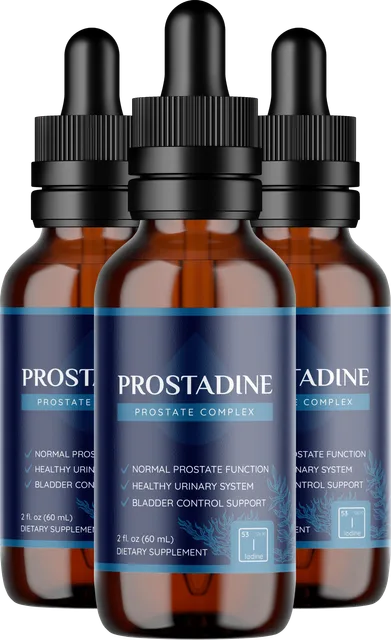
Whatever decade you are in, the goal is the same: support your prostate and bladder with good daily habits and your doctor's guidance. For the daily part, Prostadine is the support we recommend. It was made for exactly the everyday frustrations men notice as the prostate changes with age: night trips, a weak or slow stream and less reliable bladder control.†
- Liquid drops, easy to take: two full droppers (2 ml) a day, preferably in the morning — straight or stirred into tea, coffee or juice.
- Nine natural ingredients on the label: saw palmetto, pomegranate, shilajit, neem, iodine and four sea plants (nori, wakame, kelp and bladderwrack).
- Made for every stage: designed to support normal prostate function, a healthy urinary system and bladder control.†
- Clear prices: 2 bottles at $79 per bottle, 3 bottles at $69 per bottle (most popular) or 6 bottles at $49 per bottle (best value, with two bonus guides), with free US shipping.
- Protected purchase: a one-time payment with no subscription, backed by a 60-day money-back guarantee.
Prostadine is a dietary supplement, not a medication: it works alongside healthy habits and your doctor's advice, never instead of them.
Frequently asked questions
Does the prostate get bigger with age?
Yes, for most men. According to the NIDDK, the prostate has two main growth phases: one during puberty and a second that starts around age 25 and continues throughout life. Benign prostatic hyperplasia (BPH), a non-cancerous enlargement, often appears late in that second phase.
What is a normal prostate size?
In younger adult men the prostate is often described as roughly the size of a walnut. Doctors estimate size with a rectal exam or an ultrasound, and what counts as normal for you depends on your age and symptoms, so your doctor is the right person to interpret any number.
Does a bigger prostate always mean worse symptoms?
No. Size and symptoms do not always match. Some men with a fairly large prostate have few symptoms, while others with modest enlargement notice a weak stream or frequent night trips. How the gland presses on the urethra matters more than size alone.
At what age should men pay attention to prostate changes?
Urinary changes become more common after 50, but it is worth noticing changes at any age. Talk to your doctor about prostate health and screening around your 50s, or earlier if you have symptoms or a family history.
Can a supplement shrink the prostate?
No supplement is proven to shrink the prostate, and none replaces medical care. A daily formula such as Prostadine is designed to support normal prostate function, a healthy urinary system and bladder control as part of a healthy routine, alongside your doctor's advice.